
POSH Certification Training
Five modules, structured like a real compliance programme — taught by a former statutory Local Committee Chairperson.
- 5 modules
- 5 videos
- 4h 26m
- English
- Certificate of completion
- 1 year access
Taught by Adv. Madhuri Bakshi, Practising Advocate, former Chairperson, Local Complaints Committee, Faridabad
- ✓ SHe-Box empanelled expert
- ✓ 1000+ professionals trained
- ✓ 100+ organisations
What You’ll Learn
Eight outcomes, each mapped to a statutory duty.
- The POSH Act, 2013: scope, definitions, and legal foundation
- Employer obligations and the real cost of non-compliance
- Constituting and running an Internal Committee correctly
- Receiving a complaint: jurisdiction, timelines, confidentiality
- Conducting an inquiry aligned with principles of natural justice
- Evidence, documentation, and drafting a defensible report
- Annual reporting, SHe-Box submissions, and audit-readiness
- Building a prevention-first workplace culture
Who This Is For
Everyone who carries the duty.
HR & compliance teams
Own implementation end to end.
Internal Committee members
Handle complaints correctly.
Managers & leadership
Recognise, prevent, escalate.
Individuals & consultants
Students, self-employed, owners.
Prerequisites: none. The course starts from first principles and assumes no legal background.
Curriculum
5 modules · 5 videos · 4h 26m of video · 5 downloadable note sets
01Foundations of POSH1 video · Assessment
Start with the ground the law stands on. This module explains how gender, bias and stereotypes shape everyday working life, why so many women stay silent about harassment, and how the Vishaka case led India to the POSH Act, 2013. You finish with a clear picture of why the Act exists and what it set out to correct.
You will learn
- Gender sensitisation, and the difference between sex and gender
- Gender roles and stereotypes
- Gender bias in the workplace and what it costs
- Why women do not report harassment
- Why women-specific laws are necessary
- The Vishaka case and the road to the POSH Act
Key takeaways
- Bias is often invisible. It sits in systems, appraisals, hiring and meetings, not only in individual acts.
- Sex is biological, gender is social. Gender expectations are learned, and what is learned can be unlearned.
- Stereotypes assign roles by assumption instead of ability, which limits equal growth.
- Silence about harassment is rarely a free choice. It reflects fear and systems that do not feel safe.
- Women-specific laws are tools of equity, a correction for structural imbalance and not a preference.
- Vishaka (1997) held that harassment violates Articles 14, 15 and 21. The POSH Act (2013) made that protection binding law, with timelines, an Internal Committee and penalties.
- Module video31:23
02Key Definitions Under POSH1 video · Assessment
Learn the legal vocabulary the Act is built on, and use it precisely. This module covers who counts as an aggrieved woman, what a workplace includes, how sexual harassment is defined, and where the line falls between harassment, ordinary workplace conduct and consensual relationships. It prepares you to judge whether a situation falls under POSH at all.
You will learn
- Who is an aggrieved woman
- What counts as a workplace
- Employer, Internal Committee and respondent
- Sexual harassment: the definition and its two ingredients
- Quid pro quo and hostile work environment
- What is not sexual harassment, and consensual relationships
Key takeaways
- An aggrieved woman is any woman, of any age and work status, who alleges harassment at her workplace.
- A workplace covers physical, virtual, in-transit, client-site and domestic settings.
- Sexual harassment is unwelcome conduct of a sexual nature. Both elements are needed, and impact matters more than intent.
- Quid pro quo links a job benefit to sexual submission, and one incident is enough. A hostile work environment is pervasive, unwelcome sexual conduct.
- Professional discipline, accidental contact and non-sexual disputes are not sexual harassment.
- A consensual relationship is not harassment, until consent is withdrawn and the other person disregards it.
- Module video46:12
03IC, Complaint Filing & Inquiry Process1 video · Assessment
Follow a complaint from the first written word to the final action. This module covers how an Internal Committee is constituted, the powers it holds, how complaints are filed, when conciliation is possible, how the inquiry runs within 90 days, and what the findings must contain. It also explains false and malicious complaints, and when the Local Committee takes over.
You will learn
- Completing the legal foundation: Apparel Export, CEDAW and Section 3(2)
- Constitution and powers of the Internal Committee
- Filing a complaint: time limits, delay and parallel remedies
- Conciliation and the inquiry process
- Findings, recommendations and action by the employer
- False and malicious complaints (Section 14) and the Local Committee
Key takeaways
- An Internal Committee is mandatory for 10 or more employees, and a defective constitution can invalidate every proceeding it conducts.
- The IC has Civil Court powers and can recommend interim relief to protect the complainant during the inquiry.
- A complaint is made in writing within 3 months, extendable to 6 with recorded reasons. IC, police and She-Box routes can run together.
- The inquiry must finish within 90 days. Both sides are heard equally, and resignation does not stop it.
- The employer must act on the IC’s recommendations within 60 days. Not proved is not the same as false, and Section 14 needs three elements and a separate inquiry.
- The Local Committee serves small organisations, domestic workers, the unorganised sector and complaints against the employer, with the same powers as the IC.
- Module video69:45
04Employer Obligations, Policy & Compliance1 video · Assessment
See what the law expects of every employer, and what it costs to fall short. This module covers where the Act applies, the duties under Section 19, the different policy types, confidentiality, protection from retaliation, third-party and remote-work harassment, annual reporting and the penalties for non-compliance. It turns the Act into a practical compliance checklist.
You will learn
- Where the POSH Act applies
- Employer duties under Section 19
- POSH policy, gender-neutral policy and anti-sexual harassment policy
- Confidentiality (Section 17) and protection from retaliation
- Third-party, remote, virtual and gig-workplace harassment
- The annual report (Section 21) and penalties (Section 26)
Key takeaways
- The Act applies to all workplaces, sectors and worker types, including contractual and agency workers.
- Section 19 sets eight employer duties, including a safe workplace, displaying IC details, training, IC support and treating harassment as misconduct.
- Only the POSH policy meets the legal obligation. A gender-neutral or anti-sexual harassment policy adds value but cannot replace it.
- Confidentiality is absolute and breaches are penalised. Retaliation is prohibited from the moment a complaint is filed, whatever the outcome.
- Harassment by clients, vendors and visitors, and in remote or virtual work, is within the employer’s responsibility.
- Annual reports have deadlines. Fines run up to ₹50,000, doubled for a repeat offence, with possible cancellation of the business licence.
- Module video68:07
05The Complete POSH Trainer1 video · Assessment
Move from knowing the law to teaching it well. This module shows how to train Internal Committee members, why “not proved” is not the same as “it did not happen”, how Section 14 is correctly applied, and how to handle real-life grey zones and common myths. You finish with a plan for training different audiences and the habits of an excellent trainer.
You will learn
- How to train the Internal Committee
- Why “not proved” is not the same as “it did not happen”
- False and malicious complaints (Section 14)
- Dos and don’ts for every category of person
- Real-life grey zones and common myths
- Designing and delivering effective POSH training
Key takeaways
- IC training is not general awareness training. It needs at least 3 hours, six pillars and a mock inquiry.
- Not proved does not mean false. The civil standard of proof, missing evidence and trauma explain why genuine cases go unproved, and anti-retaliation duties continue.
- Section 14 needs three elements and a separate inquiry. It cannot follow automatically from a not-proved finding.
- Grey zones such as WhatsApp groups, office parties, ended relationships and client harassment each have a clear legal analysis.
- Four audiences need four sessions: all employees, IC members, senior leadership and HR, each with its own depth and tone.
- Myths must be dismantled in every session. Excellent training changes behaviour, not just records.
- Module video50:29
How It Works
Four steps from here to certified.
- 1
Register
Name, email, mobile, and your nature of work. Email is your login.
- 2
Pay securely
Pay through our secure payment gateway. Access activates the moment payment is confirmed.
- 3
Learn at your pace
Watch, pause, resume exactly where you left off. Progress saves automatically.
- 4
Get certified
Finish all modules and assessments to generate your certificate.
Secure payment gatewayUPI · Cards · Netbanking · Wallets
Certificate & Access
A record in your name, for a full year.
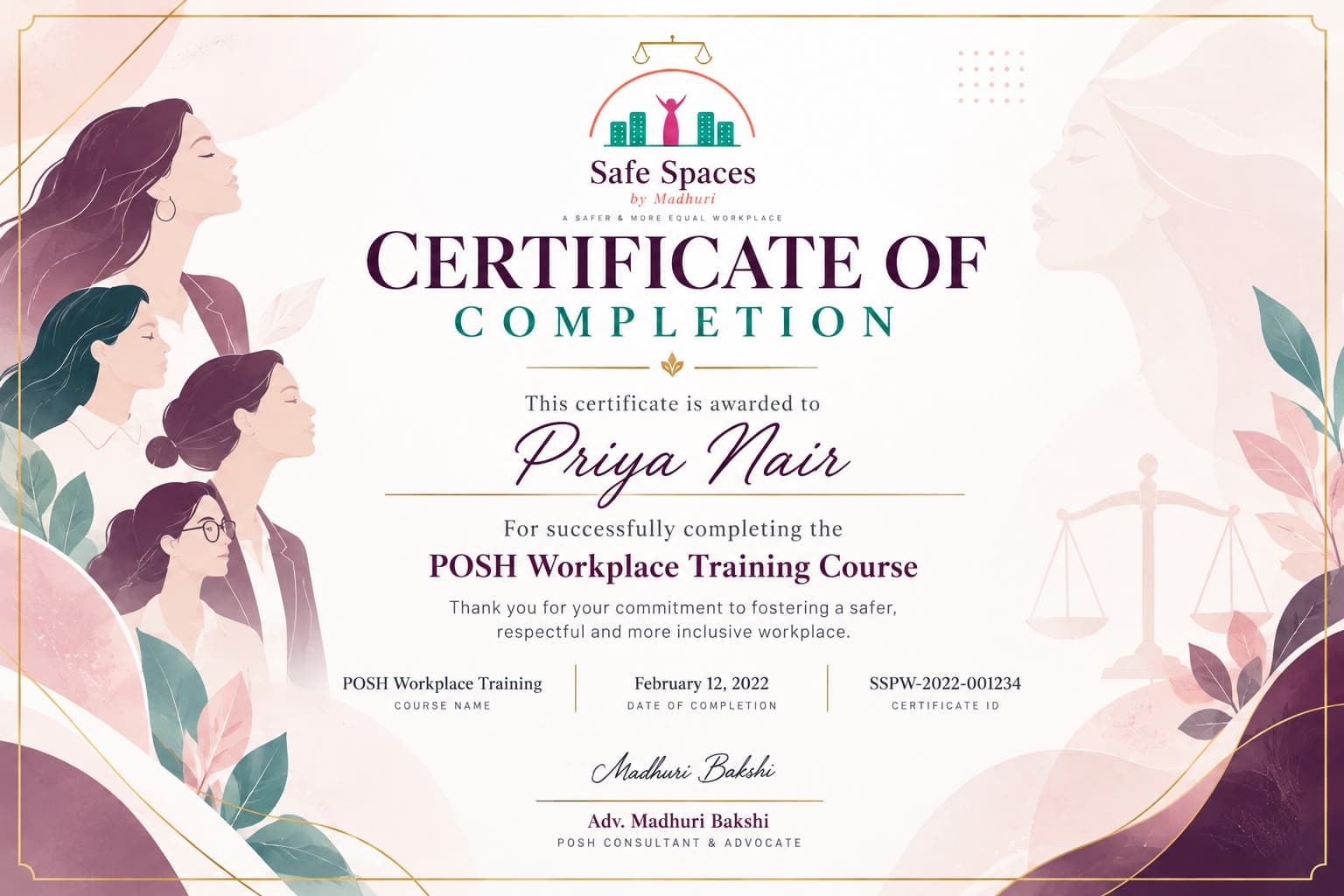
- Certificate of completionIssued by SAFE SPACES BY MADHURI in your name, with a unique certificate ID, downloadable as PDF.
- 1 year of accessRevisit any module for a full year from your purchase date.
- Learn anywhereWorks on desktop, tablet, and mobile. Playback position syncs across devices.
A certificate of completion issued by SAFE SPACES BY MADHURI. It records the training you have completed and is not a government-issued or accredited credential.
Instructor
Adv. Madhuri Bakshi
I spent nearly six years chairing the Local Complaints Committee, Faridabad, hearing complaints that organisations could not resolve internally. Most of what went wrong was procedural: a committee constituted incorrectly, a timeline missed, a report that would not survive scrutiny. I built this course so the people responsible can get those things right the first time.
- Former Chairperson, Local Complaints Committee, FaridabadServed for nearly six years, gaining extensive experience in the independent redressal of workplace sexual harassment complaints.
- Government-Appointed Inquiry OfficerExperience in conducting sensitive inquiries with fairness, impartiality, and due regard for the principles of natural justice.
- External Member, Labour Courts, FaridabadBringing independent legal expertise and an understanding of workplace grievance redressal.
- Legal Expert, Local Committee, NuhProviding legal expertise in matters relating to workplace sexual harassment.
- POSH Expert Empanelled with the SHe-Box PortalContributing to POSH awareness, training, and effective implementation of the law.
Questions Before You Buy
Who should take this POSH course?
This course is designed for anyone who wants to build knowledge and expertise in POSH (Prevention of Sexual Harassment) law and workplace safety, including advocates, law students, management students, HR and compliance professionals, Internal Committee members, corporate trainers, consultants, social workers, NGO volunteers, educators, managers, business owners and aspiring POSH trainers.
Whether you want to strengthen your professional skills, explore a career in POSH training and compliance, or contribute towards safer workplaces, this course offers a practical foundation in the POSH Act, 2013 and its application.
Is POSH training mandatory in India?
Yes. Section 19(c) of the POSH Act, 2013 requires every employer to organise awareness programmes for employees at regular intervals and orientation programmes for Internal Committee members. The Act does not prescribe a uniform annual frequency; organisations should determine an appropriate schedule in accordance with applicable requirements and their workplace needs.
Non-compliance may attract a fine of up to ₹50,000 under Section 26. A subsequent conviction for the same offence can attract enhanced consequences, including twice the punishment, subject to the statutory provisions, and possible cancellation or non-renewal of the relevant licence or registration.
Do I need a legal background to enrol?
No. No prior legal qualification is required. The course explains the subject from the fundamentals, using clear, practical explanations and workplace examples.
It is suitable for both beginners and professionals who want to strengthen their understanding of the POSH Act, workplace prevention measures, Internal Committee responsibilities and inquiry procedures.
How long is the course, and how long will I have access?
The course comprises 5 modules and 5 videos, with a total video duration of 4h 26m. Each module includes downloadable notes and an assessment.
You can learn at your own pace and revisit the lessons during your one-year access period, beginning on the date your payment is confirmed.
Can I access the course on my mobile phone?
Yes. You can access the course through a compatible web browser on your desktop, tablet or mobile phone, without installing a separate app.
You can learn at your convenience, subject to the compatibility and features of the course platform.
How do I receive my certificate?
To qualify for the certificate of completion, you must complete all 5 modules and pass the assessment in accordance with the course requirements.
If you do not pass an assessment, you may retake it in accordance with the permitted attempts and passing criteria displayed in the course. Once you have fulfilled all completion requirements, you can generate your certificate of completion as a PDF after confirming your details.
Please ensure that your name is entered correctly, as it will appear on your certificate.
Is the POSH Train the Trainer certificate recognised?
Upon successful completion of the course, participants receive a Certificate of Completion issued by SAFE SPACES BY MADHURI, recognising their completion of the POSH Train the Trainer programme.
This Train the Trainer programme is designed by Madhuri Bakshi, a practising advocate. She is the Legal Expert on the Local Committee, Nuh, an empanelled POSH expert on the SHe-Box portal, and a former Chairperson of the Local Complaints Committee, Faridabad. The programme pairs legal expertise with practical experience from her committee work. Participants gain a thorough understanding of the Sexual Harassment of Women at Workplace (Prevention, Prohibition and Redressal) Act, 2013 (POSH Act). They also build the knowledge, confidence and skills to design and deliver effective workplace awareness and sensitisation programmes.
Participants who complete the programme receive a certificate from Safe Spaces by Madhuri, a programme designed and delivered by an experienced POSH practitioner. It shows that you have built practical training skills and a working command of the POSH Act, 2013, which is a strong credential for anyone looking to lead workplace awareness and sensitisation sessions.
So that participants can represent their qualification accurately, please note that the certificate is privately issued. It is not a government-issued or accredited academic qualification. It does not by itself confer statutory recognition or government empanelment, and it does not authorise anyone to act as an External Member or to present themselves as a government-certified trainer. Appointments to Internal or Local Committees and other professional engagements remain subject to the applicable legal requirements and each organisation’s eligibility criteria. The programme is designed to prepare you to meet those requirements with confidence.
Will completing this course make my organisation POSH-compliant?
Completing this course does not, by itself, make an organisation POSH-compliant. However, it can help HR professionals, Internal Committee members, compliance teams and aspiring POSH trainers develop the knowledge and practical skills needed to support effective POSH implementation and workplace awareness initiatives.
The course focuses on understanding the POSH Act, 2013, explaining its provisions, handling workplace sensitisation sessions and developing a practical understanding of the responsibilities involved in POSH compliance and inquiry procedures.
For organisations seeking end-to-end assistance, SAFE SPACES BY MADHURI also offers POSH compliance services, including policy drafting, Internal Committee support, employee awareness programmes, compliance audits and inquiry assistance.
What if my payment fails?
Payments are processed through the payment gateway offered on our website. Available payment methods may include UPI, debit or credit cards, net banking and wallets, depending on the gateway.
If a transaction fails after the amount has been debited, the reversal or refund is generally handled through the payment provider and the relevant bank, in accordance with their applicable procedures.
If the amount has been debited but your course access has not been activated, please contact us with your payment reference or transaction ID. We will verify the transaction and assist you in resolving the issue, including arranging a refund where applicable.
Can I get a refund?
Please review the course curriculum and the applicable terms before making your purchase.
Since access to the digital course is intended to be activated upon successful payment, purchases are non-refundable once access has been granted.
A refund or appropriate resolution will be provided in eligible cases, including duplicate payments or payments for which course access has not been provided, subject to verification and the applicable policy.
For complete details, please read our Refund and Cancellation Policy before purchasing the course.
Can I purchase the course for my entire team?
Yes. We offer enrolment options for organisations and teams.
Each participant requires an individual account and enrolment. Course access is intended for the enrolled participant and cannot be shared. Each learner can complete the modules and assessments individually and obtain their own certificate upon fulfilling the course requirements.
For bulk enrolments or organisational training requirements, please contact us to discuss suitable options.
Do you also conduct live POSH training?
Yes. In addition to our online course, SAFE SPACES BY MADHURI offers professional POSH services, including employee awareness programmes, Internal Committee training, workplace sensitisation workshops, POSH policy drafting, compliance audits, inquiry support and External Member nomination, subject to engagement and availability.
Programmes can be customised for corporate offices, manufacturing organisations, hospitals, educational institutions and other workplaces, and may be conducted online, offline or in a hybrid format, depending on the requirement.
Please contact us to discuss your organisation’s specific needs and the appropriate scope of services.
Start your POSH certification today
5 modules. 1 year of access. A certificate in your name.
Original price ₹9,999Now ₹4,999 + 18% GST
